



Heyyyyyyyyyyy!!!!!!
Have you had a DNA test on your equine partner & discovered they have MPH DNA in their top 3 genetic matches?
Do you love certain traits about your horse?
Traits like conformation, temperament, and bravery can all be passed genetically, from generation to generation.
If so, we have exciting news for you!
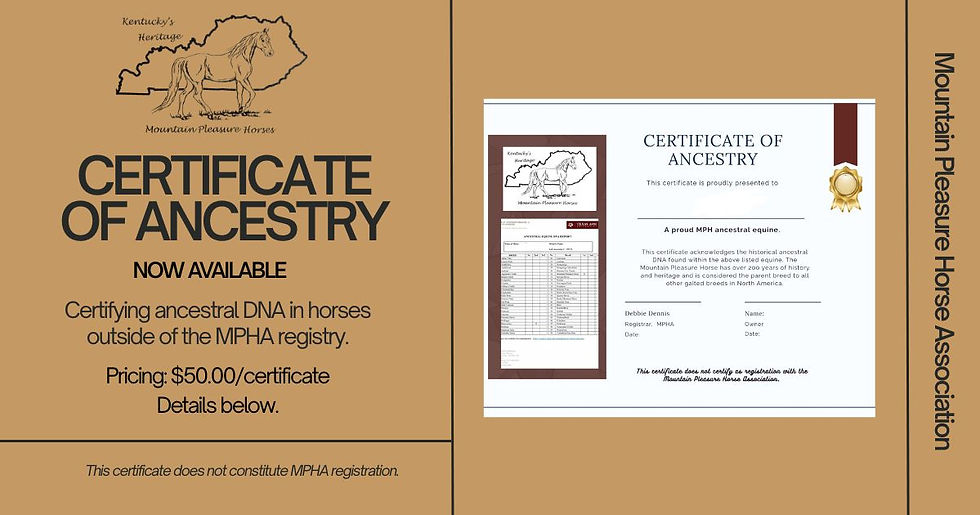
The MPHA is now accepting applications for our NEW program: Ancestral DNA Certification.
This certificate recognizes your horse’s connection to the critically endangered Mountain Pleasure Horse DNA.
This certificate includes:
• MPHA Membership
• Inclusion in select MPHA events
• Recognition of MPH ancestry
Please note: This is NOT an MPHA registration certificate. However, we are excited to celebrate and document horses carrying MPH ancestry!
We are proud to welcome you and your horse into the MPH community!
Program Rules:
Sign Up:
Program Disclaimer:
MPHA Certificate of Ancestry Program- Rules:
-
Horse must provide DNA proof of ancestry from an approved lab (ex. Texas A&M, UC Davis)
-
Horse must show MPH as a primary breed (1, 2 or 3) on DNA report
-
Must include picture of horse for certification
-
$50 payment (paypal or check) will include Certificate of Ancestry and annual MPHA membership
-
Horses with MPH Certificate of Ancestry will be welcome to participate in the Versatility/Trail Program, but will not qualify for the KBIF program.
-
This certificate will NOT qualify horse to register with MPHA
How to Sign Up:
1. Submit DNA report from approved lab along with pics (front, back and both sides) to mphareg@ymail.com
2. Fill out an MPHA membership form
3. Pay $50.00 fee via PayPal or check to MPHA, P.O. Box 5, Jeffersonville, Ky 40337
MPHA Certificate of Ancestry Program
**Disclaimer – Certificate of Ancestry does NOT qualify for registration with MPHA
Equine DNA breed and ancestry testing is considered more of a statistical probability indicator than an exact science. While parentage verification is highly accurate (>99%), breed composition testing has severe limitations.
Equine DNA tests compare your horse’s genetic markers to a reference library of different breeds.
-
Percentage breakdowns are largely unreliable: Unlike dog DNA tests, most equine tests cannot reliably give you an exact percentage (e.g., 25% Quarter Horse, 75% Thoroughbred) because horse breeds are genetically very similar.
-
What it actually shows: Results generally indicate which specific breeds your horse's DNA most closely resembles or shares the most markers with.
Per Texas A&M website:
Horse ancestry testing in our lab at Texas A&M is based on comparing the DNA genotype of the subject horse to a reference panel of 50 horse breeds. Using a computer program based on maximum likelihood analysis, the variants present at each genetic marker system tested for the subject horse are compared to those for each reference breed. For each breed comparison the probability that the subject horse came from that breed is calculated based on the product of all the systems genotype probabilities.
We then report the three breeds with the highest probability that the subject horse could have come from, in order of their probability of being an ancestral breed. The results cannot give the proportion (percent) of the breed that the subject horse may have. That really isn’t possible because horses are so genetically similar. The test is reasonably good, but there is no way to determine how accurate it is. If a purebred horse is tested, it will almost always be assigned to the correct breed. When a two breed cross is examined, the two parental breeds will almost certainly be given very high probabilities, although not necessarily the first and second assignments. The more breeds involved in a cross the lower the probability that a good result will be delivered.
Also, understand that even though three breeds are reported, that does not mean the subject horse has all three in its ancestry. Another point is that breeds within a group of related breeds will be given similar probabilities. Thus, the subject horse may be half Belgian draft and half Suffolk, but the test results may show Percheron or even a pony breed. That is because these draft breeds are very similar at the level we can test and the true pony breeds are closely related to the heavy draft breeds. As well, many breeds have Thoroughbred in their make-up and they will give similar results and will often show similarity to Warmblood breeds.